
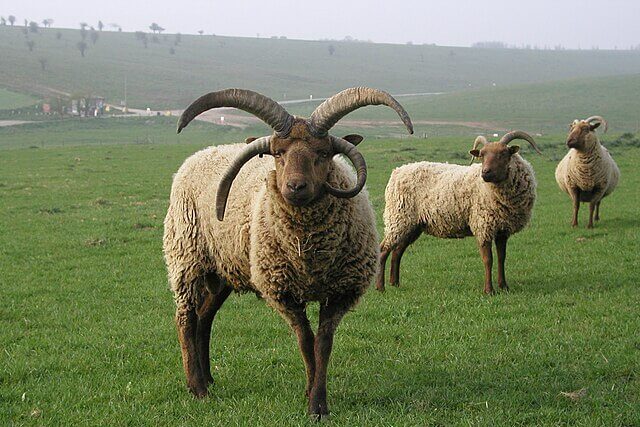
With their distinctive four horns, the rams of the ancient Manx Loaghtan sheep are striking animals – but despite their unique appearance, the future of this Iron Age breed native to the Isle of Man remains uncertain.
The Manx Loaghtan was placed on the Rare Breeds Survival Trust’s urgent priority list earlier this year, after the charity recorded a 34% drop in pedigree lambs since 2022.
Jenny Shepherd – aptly named for her profession – and her partner own the world’s largest flock of Manx Loaghtans at Ballacosnahan Farm. They hope to raise awareness of the breed’s potential and prove its commercial viability.
Ms Shepherd describes them as “amazing sheep”, praising their “fabulous wool” and explaining that their meat is “more like venison than lamb, which absolutely lends itself to charcuterie”.
The couple have reared Loaghtans since 2003 on their 200-acre (80-hectare) farm, which stretches from the top of Slieau Whallian down to the River Neb. She said the wide range of terrain makes the breed “perfect for conservation grazing”.
“They thrive on rough moorland where you’ve got loads of different wild flowers and plants, and they just do much better on that sort of ground,” she said.
The Manx Loaghtan has a history on the island stretching back around 1,000 years, but numbers declined significantly in the early 19th Century when larger, faster-maturing white sheep became more widespread.
“Over the 1800s they almost completely displaced the Loaghtans,” she added.
According to Ms Shepherd, it was Ceaser Bacon who recognised the crisis, gathering the remaining animals and realising in 1895 that he had just four breeding-fit ewes left to rebuild the population.
“So most of the world population comes from those four ewes”, Ms Shepherd explained, adding it was “an amazing story of survival”.
Although Loaghtans take longer to mature and require winter care, Ms Shepherd said their meat is “really quite special” and their wool commands a much higher value than that of white sheep.
Despite owning the largest flock in the world, Ms Shepherd added that this is “not a badge I wear with pride” – highlighting just how vulnerable the breed remains.
“I would love it if there were some other big commercial Loaghtan farms because that would be much safer for their future,” she said.
“It’s really sad [that] they’re so endangered – they’re truly Manx animals.”
Alice Lennox, the Scottish co-ordinator for the Rare Breeds Survival Trust, said: “Unfortunately, since 2022, there’s been a 34% decrease in the number of Manx Loaghtan dams producing pedigree offspring.
“Their rarity is precisely why it’s important to maintain them and using them sustainably through wool production, meat production, and habitat management, that will help secure their future.”
She added that “eating them actually is supporting them”.
“There is a merit in economic incentive, in buying their meat, eating them – and it gives farmers a reason to keep them and breed them as well,” she said.
——————————————————————————
At Natural World Fund, we are passionate about restoring habitats in the UK to halt the decline in our wildlife.