Wildfires in Canada are increasingly burning for multiple years, with so-called “zombie fires” smouldering underground through winter and reigniting in spring, according to scientists studying the rapidly warming boreal regions.
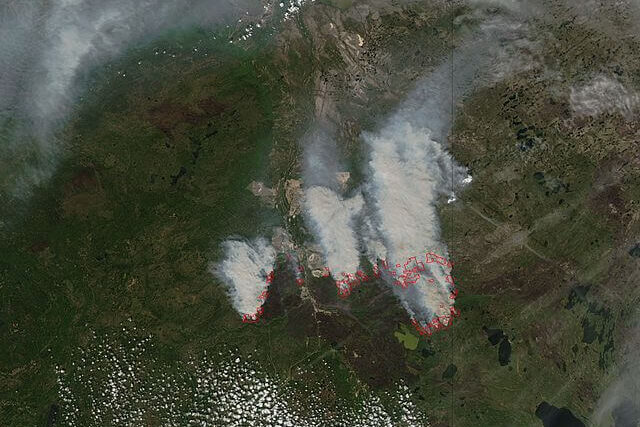
In May 2023, a lightning strike ignited a wildfire in the Donnie Creek area of British Columbia. Although it was early in the fire season, dry conditions following a warm spring and dry autumn allowed the flames to spread rapidly.
By mid-June, the fire had grown into one of the largest in the province’s history, burning an area of boreal forest almost twice the size of central London. That year, Canada experienced its most destructive wildfire season on record.
Fire Smouldered Through Winter and Re-emerged in Spring
Wildfires typically end when cold weather and snow arrive. However, the Donnie Creek fire continued to burn beneath the surface, insulated from freezing temperatures by a thick snowpack.
The following spring, the underground blaze re-emerged as a zombie fire and continued burning until August 2024. By then, more than 600,000 hectares (1.5 million acres) of land had been destroyed.
What Are Zombie Fires and Why Are They Increasing?
Zombie fires, sometimes revealed by plumes of steam rising from frozen ground, were once rare across the boreal forests of Canada, Alaska and Siberia.
As global temperatures rise, these overwintering fires are becoming more common. Although often small and difficult to detect, they can turn wildfires into multi-year events and significantly alter soil ecosystems, making forest recovery more difficult.
“It is a massive problem,” says Lori Daniels, a forest and conservation sciences professor at the University of British Columbia. “Zombie fires, also called holdover fires, are fires that move into the organic soil matter and smoulder. It’s a very slow, but hot, combustion through a prolonged period and then they resurface. In December 2023, we had over 100 fires that were still burning, and in the spring of 2024, they continued to burn,” she says.
Permafrost Fires Release Major Carbon Emissions
While only around 15% of the northern hemisphere is underlain by permafrost, these frozen soils store roughly twice as much carbon as is currently in the atmosphere.
Zombie fires burn slowly at lower temperatures, releasing large amounts of particulate pollution and greenhouse gases as they consume carbon-rich soils, increasing their impact on climate change.
“These boggy soils take hundreds to thousands of years to accumulate the carbon that is stored in the organic soil layers. In some cases, it’s burning right down to the rock,” says Daniels. “Over a very short period of time, we are combusting all of this ancient carbon into the atmosphere. It becomes a feedback loop with tremendously negative consequences for the ecosystem. It changes the hydrology – you’re losing the substrate and the seed banks within them, you’re changing the soils to some sort of mineral base instead of an organic base,” she says.
Repeated Burning Damages Forest Regeneration
Low- to medium-intensity fires can help forests regenerate by clearing space and releasing seeds stored in peaty soils. After these burns, vegetation often returns quickly.
However, repeated heating from zombie fires can destroy seed banks, leaving behind mineral soils made up mainly of sand, clay and silt. This significantly slows ecosystem recovery and makes it harder for forests to regrow.
Scientists Race to Detect Arctic Holdover Fires
Because zombie fires burn underground, they are difficult to identify. Scientists are developing new satellite-based methods to detect holdover fires in Arctic and sub-Arctic regions.
While most wildfires are caused by humans or lightning, zombie fires present new challenges for fire management, forcing crews to monitor and contain blazes throughout the year.
Similar patterns are thought to be occurring in Siberia, which has also experienced large wildfires in recent years, although limited international collaboration has restricted research in the region.
The problem can also compound itself. Patrick Louchouarn, a professor at the School of Earth Sciences at Ohio State University, says: “This has the potential to become really problematic. The more of the permafrost dries out and some of those organic, rich soils dry out in the Arctic, and the more you increase the temperature, there’s greater possibility for that fuel to be ready to burn.”
Canada’s 2025 Wildfire Season Started Early
In 2025, Canada’s wildfire season began early once again. By mid-September, about 8.8 million hectares (21 million acres) had burned across hundreds of fires nationwide.
Researchers believe many of the early fires were likely zombie fires carried over from previous years, highlighting how the planet’s northern regions — which are warming faster than the global average — are increasingly vulnerable to long-lasting wildfires.
Communities on the ground are already feeling the shift. Jennifer Baltzer, a professor at Wilfrid Laurier University, says: “In 2023, we had this crazy fire season in the Northwest Territories. Seventy percent of the region was evacuated and it was very traumatic. People were driving through crazy fires to get away from their homes. There were lots of these overwintering fires around communities that had to be evacuated.
“It adds to the stress that people in these ecosystems are facing. Usually the winter is the season where you can feel like you’re safe from fire.”
——————————————————————————
At Natural World Fund, we are passionate about restoring habitats in the UK to halt the decline in our wildlife.