
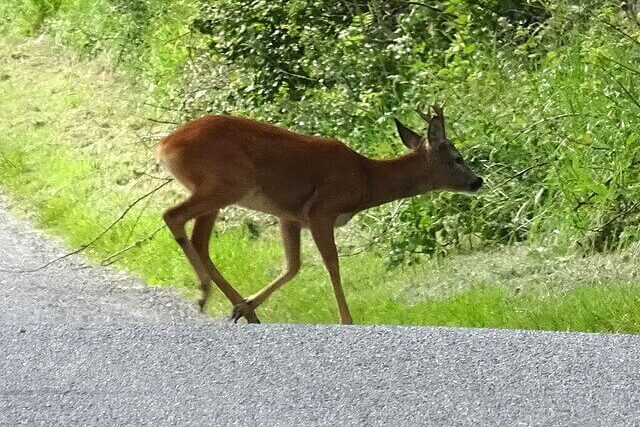
Deer Numbers Surge Across Britain, Putting Nature and Communities Under Pressure
Deer are becoming an increasingly common sight in towns, villages and cities across Britain — and their rising numbers are bringing growing environmental, economic and social costs.
Ben Martill often watches deer roaming below his flat in the market town of Horsham, West Sussex — despite living on a busy road rather than near woodland. He regularly sees deer crossing main roads and has narrowly avoided collisions while driving.
“I clipped one, poor thing. It darted off into the bushes.”
A gardener by trade, Mr Martill says some of his clients have had fences destroyed and trees stripped of bark by deer.
Scenes like this are becoming more common nationwide as deer populations continue to rise.
Deer Population Has Quadrupled Since the 1970s
Deer numbers in Britain have surged over the past 40 years. While exact figures are unknown, the Forestry Commission and Defra estimate there may now be around two million deer — up from about 450,000 in the 1970s.
Experts say the situation worsened after the Covid-19 pandemic, when deer culling dropped sharply. Jonathan Spencer, former head of planning and environment at Forest Enterprise, said populations are now “completely out of hand”.
“There has to be a lot more recognition of the scale of the problem and some rather hard-hearted approaches like rounding up the deer and shooting them in an enclosure,” he argues. “That would go down like a lead brick socially”.
Environmental Damage and Economic Costs Mount
Rising deer numbers are affecting farmers, drivers, businesses and wildlife. In Scotland alone, Forestry and Land Scotland estimated deer damage to young trees in national forests cost £3m a year in 2021.
Lucy Manthorpe, who runs a 400-acre organic arable farm in Suffolk, said she was losing more than £10,000 worth of crops annually to deer damage before hiring a full-time worker to manage culling.
Farmers with high-value crops can face losses of up to £1m a year, according to the Forestry Commission.
The AA estimates up to 74,000 deer are killed or injured on UK roads each year, leading to hundreds of human injuries and occasional fatalities. In October, a 63-year-old motorcyclist in Oxfordshire died after colliding with a deer.
High deer densities also prevent natural woodland regeneration. Alison Field, president of the Royal Forestry Society, said tree regrowth becomes “almost impossible” when deer consume young shoots as they appear.
“The pressure of the deer now has become so great that we’ve lost the balance out of our landscape.”
Experts Warn Current Culling Levels Are Insufficient
Around 350,000 deer are removed from the landscape each year through hunting and culling, according to the Country Food Trust. However, parliament was told in 2023 that up to 750,000 deer a year may need to be culled to stabilise the population.
A 2013 study by the University of East Anglia suggested that around half of Britain’s deer population would need to be shot annually to prevent severe damage to woodlands and birdlife.
No Natural Predators and Fragmented Responsibility
Britain’s mild climate, lack of apex predators and limited human hunting make it ideal deer habitat. Only two of the six species now present — red and roe deer — are native.
Because deer are legally classed as res nullius — belonging to no one — responsibility for managing numbers falls to individual landowners, leading to inconsistent approaches across landscapes.
“A few centuries ago deer were the property of a privileged few in deer parks, royal forests and chases,” says Mr Spencer.
There is broad agreement among conservationists, farmers and government that deer numbers must be reduced. In 2022, Defra acknowledged: “We need to do more to sustainably manage deer.”
But how to do that remains contentious. Some animal rights groups favour non-lethal methods such as contraception or fencing. However, the British Deer Society says these approaches are difficult to scale, costly, and can exclude other wildlife.
Predator Reintroduction Divide Opinion
Some rewilding projects, particularly in Scotland, have proposed reintroducing apex predators such as lynx — and, more controversially, wolves — to control deer numbers naturally.
Dr Mike Daniel, who runs a Sustainable Deer Management course at the University of the Highlands and Islands in Perth, says: “Ecologically, wolves and lynx could thrive in the UK.” But such plans would face likely opposition from farmers, landowners and local communities.
Environmental campaigner George Monbiot has said predators could “get on with the job”, while Trees for Life argues lynx could bring ecological benefits.
But farming groups warn of serious consequences. Countryside Alliance chief executive Tim Bonner said wolf reintroduction would “bring misery for livestock farmers”, and that lynx could only ever make a small contribution to deer control.
And Dr Daniel agrees that it would be difficult to have wolves and lynx co-exist alongside farms and estates: “Being honest, it’s not a panacea,” he says.
Venison Consumption Seen as Part of the Solution
Many experts agree that eating more wild venison could help manage deer numbers humanely. Venison is lower in saturated fat than beef and has a smaller environmental footprint than farmed meat.
“From a human point of view [deer] are a sustainable, natural resource,” argues Charles Smith-Jones, a technical adviser at the BDS.
However, while professional cullers exist, 70% of deer shot in Britain are killed by people not employed to do so, raising questions about consistency and welfare standards.
But there is also the question of what is most humane for the animals. Elisa Allen, vice-president of People for the Ethical Treatment of Animals (Peta), says: “We don’t need to eat deer – and deer don’t wish to be eaten.” She calls instead for “humane, sustainable methods of population control”.
Scotland is currently considering new legal powers to tackle deer numbers in areas facing biodiversity and climate pressures. England has consulted on deer management reforms, though conclusions have yet to be published.
Wales and Northern Ireland are also reviewing strategies as deer numbers rise.
Managing Deer Can Restore Nature
On Lucy Manthorpe’s farm, sustained deer control has transformed the landscape. Previously barren areas are now home to oxlips, early purple orchids and rare trees, while moths and breeding birds have returned in significant numbers.
“The deer are not deciding what’s going to happen any more,” she said. “Nature is deciding.”
For conservationists, the message is clear: controlling deer numbers is not just about agriculture or safety — it is central to restoring Britain’s ecosystems.
——————————————————————————
At Natural World Fund, we are passionate about restoring habitats in the UK to halt the decline in our wildlife.