
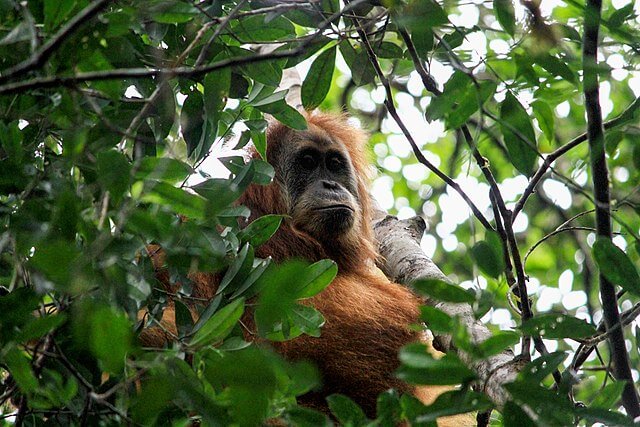
Floods Push World’s Rarest Great Ape Towards Extinction
Catastrophic flooding in Indonesia has dealt what scientists describe as an “extinction-level disturbance” to the Tapanuli orangutan, the world’s rarest great ape.
In North Sumatra, torrential rains in late November triggered deadly floods and landslides that killed an estimated 33 to 54 critically endangered Tapanuli orangutans (Pongo tapanuliensis). Fewer than 800 individuals were thought to remain in the wild before the disaster, all confined to a single, increasingly fragmented forest landscape.
“It’s a total disaster,” said biological anthropologist Erik Meijaard, one of the first experts to describe the species. “The path to extinction is now a lot steeper.”
“One of the rescue team members who was in search of human casualties had shown me a body believed to be an orangutan that was found in the logs and mud,” said Panut Hadisiswoyo, founding director of the Orangutan Information Centre in Indonesia. “After seeing the photos, I am confident that the decayed body, reddish hair and the size of the skull was a Tapanuli orangutan.”
A Devastating Blow to a Fragile Population
More than 1,000mm of rain fell in just four days, sweeping away forests and wildlife. Scientists warn that the loss of up to 10.5% of the entire Tapanuli population in a matter of days represents a critical demographic shock for a species that reproduces only once every six to nine years.
Biologists say even an annual loss of just 1% would be enough to drive the species to extinction.
“There are very few modern precedents for a shock of this scale to a great ape population,” said conservation scientist Erik Meijaard, comparing the event to Ebola outbreaks that devastated gorilla and chimpanzee populations in central Africa in the 2000s.
Forest Habitat Swept Away
Satellite imagery shows that nearly 4,000 hectares of previously intact forest were destroyed by landslides and flooding, with a further 2,500 hectares likely damaged but obscured by cloud cover. Vast scars cut through the mountainous landscape, some stretching more than a kilometre wide, stripping hillsides of trees, soil and wildlife.
The destruction has left surviving orangutans without food sources or shelter, increasing their vulnerability in an already degraded environment. Other wildlife, including elephants, are also believed to have been killed.
David Gaveau, a remote-sensing expert and founder of the conservation startup the Tree Map, said he was flabbergasted by the before and after comparison of the region.
“I have never seen anything like this before during my 20 years of monitoring deforestation in Indonesia with satellites,” he said.
“The rainfall was intense. If you lose your fruit, you lose your flowers, there will be a significant reduction in habitat quality,” Meijaard said.
Climate Change and Deforestation Intensify Disaster
A rapid analysis by World Weather Attribution found that climate breakdown likely increased rainfall intensity in the region by between 28% and 160%. Indonesian authorities also acknowledged that deforestation and land degradation had worsened the impacts of the flooding.
The Batang Toru ecosystem — the only place on Earth where Tapanuli orangutans live — has long been under pressure from mining, palm oil plantations and a large hydropower project. Conservationists have raised particular concern over recent expansion plans at the Martabe Gold Mine, which began opening a second pit close to orangutan habitat shortly before the floods.
Calls for Urgent Protection
In response to the disaster, Indonesia’s environment ministry has temporarily halted all private-sector activity in the Batang Toru area. Orangutan experts are calling for an immediate stop to all development that could further damage the remaining habitat, alongside urgent field surveys to assess surviving populations.
They are also urging the expansion of protected areas and the restoration of degraded lowland forests to give the species a chance of recovery.
After the landslides, conservationist Hadisiswoyo said, the forest had fallen “eerily quiet” — a chilling sign of how close the Tapanuli orangutan now stands to extinction.
“This fragile and sensitive habitat in West Block must be fully protected by halting all habitat-damaging development,” he said.
——————————————————————————
At Natural World Fund, we are passionate about restoring habitats in the UK to halt the decline in our wildlife.