
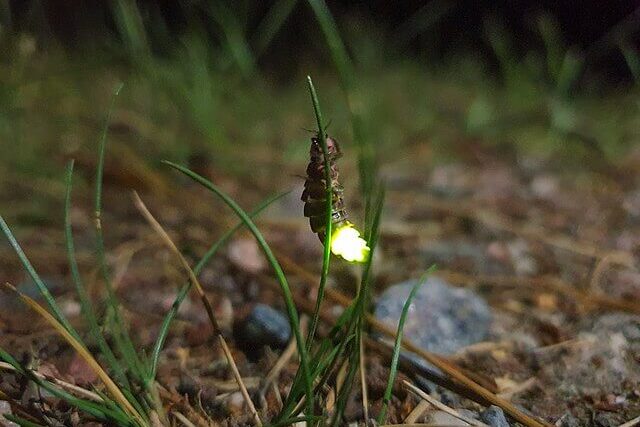
For nearly two decades, Peter Bright and fellow volunteers have scoured the village’s hedgerows and grasslands in search of bioluminescent beetles as part of the UK glow-worm survey. In most years, their counts range from 100 to 150 individuals, peaking at 248 in 2017.
However, following last year’s exceptionally wet summer and this year’s contrasting dry conditions, their numbers have dropped sharply. “We barely found 50,” says Bright, a retired science teacher leading a late-night glow-worm walk.
Glow-worms and fireflies encompass around 2,200 species of bioluminescent beetles around the world, with 65 found in Europe. The UK hosts two species, including the common glow-worm (Lampyris noctiluca) — not actually a worm, and only the females glow brightly. Italy, by comparison, is home to 17 species.
Across Europe, five glow-worm species face extinction, two are classed as endangered, and the common glow-worm is listed as near threatened by the International Union for Conservation of Nature (IUCN).
An 18-year survey by Tim Gardiner shows L. noctiluca numbers falling by around 3.5% each year. Similar patterns are emerging in France, Germany and Spain. Because glow-worms live discreetly within vegetation, population trends remain difficult to measure accurately.
“There is so much that we don’t know about fireflies,” says Ana Catalán, who researches firefly genomics at Germany’s Ludwig Maximilian University of Munich.
The Threats Behind the Glow-Worm Decline
“We need more data,” says Alan Stewart, an ecologist at the University of Sussex, adding: “We haven’t really got the luxury of waiting another 50 years to find out.”
Glow-worms are vulnerable to a range of pressures. Hotter summers threaten the slugs and snails that larvae depend on, while habitat loss and fragmentation have wiped out entire populations. Female glow-worms cannot fly and spend their lives near their birthplace, meaning even minor landscape changes — such as a new ditch — can devastate their numbers.
Light pollution further disrupts breeding. Artificial lighting can draw males away from the soft green glow emitted by waiting females. Similar declines are being recorded across Europe.
In northern Italy, increased agricultural activity has reduced firefly numbers. Apennine mountains has been linked with declining numbers of a range of different species, according to a 2020 study published in the journal BioScience.
While in Spain the abandonment of small orchards — and the resulting lack of irrigation — makes conditions harder for snails and glow-worms alike. In both countries, more streetlighting correlates with fewer glow-worms.
How People Are Helping Glow-Worms Recover
Concerned individuals are taking action. In Mantua, Italy, physics professor and light-pollution expert Fabio Falchi has reduced outdoor lighting in his garden and allowed vegetation to grow naturally.
Now, Falchi says: “Every May, our lawn comes alive with their tiny flickers. It’s beautiful to watch them move.” Their cat, he adds, is mesmerised.
Others are attempting more ambitious interventions. Since 2020, ecologist Pete Cooper has been breeding glow-worms in captivity to reintroduce them to areas where they have disappeared. In partnership with Restore, an ecological restoration company, and the Wildwood Trust, captive-bred glow-worms will soon be released into Nosterfield Nature Reserve in North Yorkshire.
However, Cooper notes it may take years to assess success, as glow-worms have a two-year life cycle.
“That’s the thing with glow-worm reintroduction – it’s not as simple as you’d think.”
Tyler says: “We don’t know what habitat is good for them, in any detail. You can find sites that look ideal, but if you try to introduce or reintroduce glow-worms, you can never guarantee that they’ll take.”
Reintroductions remain controversial. Some enthusiasts fear such projects could divert attention from protecting existing habitats or encourage developers to build on ancient countryside.
“Before you reintroduce something, you really need to know why it disappeared in the first place,” says Stewart. “Otherwise, they’re not going to survive.”
Gardiner suggests that rewilding — particularly in riverside areas where glow-worms thrive — can support natural population recoveries.
“You need to manage the habitats quite well,” he says. “The corridors between them have disappeared in the last 70 years – hedgerows removed, meadows ploughed up.”
Community Conservation Efforts Bringing Hope
Some rewilded sites are already seeing encouraging signs. In the early 1990s, volunteers in the Italian village of Binasco restored a plot of land between a highway and a sports pitch. Within a few years, fireflies began to increase.
Ruggero Rognoni, from the local environmental association, says the community helped protect the site by organising night-time firefly walks for families — a tradition that continues today.
“We realised that to protect and preserve this place, we had to make people love it,” Rognoni says. “That’s how we’ve managed to protect it,” he says.
Similar guided walks are gaining popularity across Europe. On the glow-worm walk in Westbury-sub-Mendip, residents gather on quiet lanes while a barn owl screeches overhead. Over two hours, a handful of glowing females are spotted at ankle height.
Amanda Bennett, 48, gently lifts one from the grass, watching the green light shimmer across her palm. “I can’t believe I’ve never seen one before,” she says.
Tyler was first introduced to them around 50 years ago, in a friend’s garden. “I didn’t even know they were real,” he says. “It was like looking down on a village,” he adds. “All these dots of light.”
Glow-worms were once a far more familiar sight — something many people remember from childhood summer evenings.
John Horne, an amateur naturalist in Hampshire, first discovered glow-worms in his garden 25 years ago, later even finding the rarer Phosphaenus hemipterus. Despite concerning trends, he remains cautiously optimistic.
“The average glow-worm female lays 100 to 150 eggs – it’s a numbers’ game,” he says. “You might have a brilliant year, and then it might suddenly crash.”
Cooper agrees that glow-worms have a special ability to inspire. Where other insects struggle to capture public imagination, glow-worms often serve as a “gateway” to reconnecting people with nature.
Tyler says: “If it has to start with something that glows out of its bottom, then so be it.”
——————————————————————————
At Natural World Fund, we are passionate about restoring habitats in the UK to halt the decline in our wildlife.