
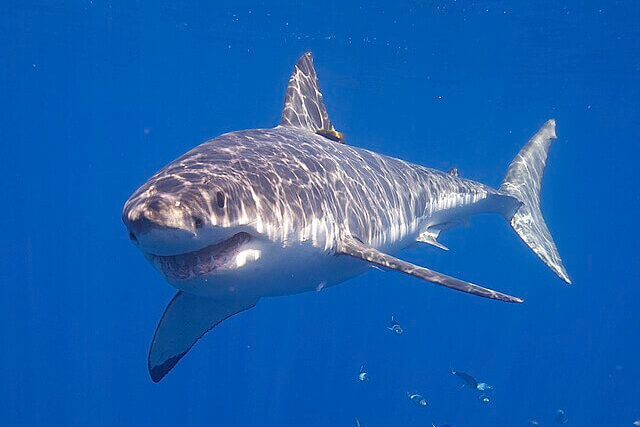
Great White Sharks Face Extinction in the Mediterranean
Great white sharks in the Mediterranean Sea are at serious risk of disappearing, with illegal fishing and weak enforcement of protections driving their decline, new research has found.
Illegal Shark Fishing Exposed in North Africa
Scientists from the United States, working with UK marine conservation charity Blue Marine Foundation, have uncovered evidence that some of the Mediterranean’s most threatened shark species are being caught and sold in North African fish markets.
Despite being protected under international law, great white sharks are still appearing in ports and markets across the region.
By monitoring fishing ports along the North African Mediterranean coast, researchers estimate that at least 40 great white sharks have been killed so far in 2025 alone.
“This is a lot for a critically endangered population,” he said.
Verified footage shared on social media shows protected sharks being landed dead at ports in countries including Algeria and Tunisia. One video shows a large great white shark hauled ashore in Algeria, while another appears to show the heads and fins of a short-finned mako shark laid out for sale in a Tunisian market.
Protected Species Still Being Sold
Great white sharks are one of more than 20 shark species in the Mediterranean that are protected under international law. It is illegal to fish for them, land them or sell them.
Other protected species include mako sharks, angel sharks, thresher sharks and hammerheads. In total, 24 threatened shark species are covered by international protections signed by the EU and 23 Mediterranean nations.
Under these rules, protected sharks must not be retained on board, landed, stored, sold or displayed, and should be released alive wherever possible.
Critically Endangered Mediterranean Shark Populations
According to lead researcher Dr Francesco Ferretti of Virginia Tech, shark populations in the Mediterranean have declined dramatically in the Mediterranean in recent decades, with great white sharks suffering some of the steepest declines.
“No other stretch of water is fished like the Mediterranean Sea,” he said, speaking to the BBC News science team while working on a research vessel off the coast of Sicily in late 2025.
“The impact of industrial fishing has been intensifying… and it’s plausible that they will go extinct in the near future.”
The Mediterranean great white shark population is now classified as Critically Endangered by the International Union for the Conservation of Nature, highlighting an urgent risk of regional extinction.
In an effort to locate and study surviving sharks, Dr Ferretti and his team conducted fieldwork in the Strait of Sicily, an area between Sicily and North Africa identified as one of the last remaining strongholds for several threatened shark species.
A key goal of the expedition was to attach a satellite tracking tag to a great white shark, something that has never been achieved in the Mediterranean.
No Sharks Found Despite Major Effort
To attract sharks, the team deployed more than three tonnes of fish bait, including frozen mackerel and tuna scraps, along with 500 litres of tuna oil to create a scent trail detectable from long distances.
Over two weeks, researchers baited the water, collected seawater samples to test for shark DNA and deployed underwater cameras. Despite these efforts, they did not encounter a single great white shark, capturing only a brief image of a blue shark.
“It’s disheartening,” Dr Ferretti told us. “It just shows how degraded this ecosystem is.”
While the team was searching for sharks, they received reports that a juvenile great white had been caught and killed in a North African fishery just 20 nautical miles from their research location.
It remains unclear whether the shark was accidentally caught as bycatch or deliberately targeted. Researchers believe this incident forms part of a wider pattern of ongoing illegal catches.
Weak Enforcement Undermines Shark Protection
Although international agreements prohibit the capture and sale of protected sharks, enforcement varies widely between countries. Current regulations do not adequately address accidental bycatch, which conservationists say is a major loophole.
James Glancy from Blue Marine Foundation said investigations had found multiple great white sharks openly sold in Tunisian markets.
“It shows that there is wildlife left,” he said. “And if we can preserve this, there is a chance of recovery.”
Glancy noted a troubling but complex reality. In some coastal communities, fishers who accidentally catch sharks face a stark choice between releasing a protected species or feeding their families.
Sara Almabruk of the Libyan Marine Biology Society said most shark catches in North African waters are accidental, underscoring the need for better support for fishers alongside stronger conservation enforcement.
“Why would they throw sharks back into the sea when they need food for their children?
“If you support them and train them in more sustainable fishing, they will not catch white sharks – or any sharks.”
James Glancy from Blue Marine added that if countries around the Mediterranean worked together, “there is hope.
“But, he added, “we’ve got to act very quickly”.
Urgent Action Needed to Save Mediterranean Sharks
Conservation groups warn that without immediate action to strengthen enforcement, reduce bycatch and support sustainable fishing, great white sharks and other iconic species could vanish from the Mediterranean entirely.
Protecting these apex predators is essential not only for marine biodiversity, but for the health and balance of the entire Mediterranean ecosystem.
——————————————————————————
At Natural World Fund, we are passionate about restoring habitats in the UK to halt the decline in our wildlife.